As an Amazon Associate and an AliExpress affiliate, TechGurl earns from qualifying purchases. Some links on this page are affiliate links — if you buy through them we may receive a commission, at no extra cost to you. This never affects which products we cover or what we say about them.
{“title”: “Best Drones for 2026: Top Picks for Every Pilot”, “seo_title”: “Best Drones 2026: Top Picks for Every Pilot”, “meta_description”: “Discover the best drones for 2026 with our expert guide. Compare top models for photography, beginners, and pros.”, “focus_keyword”: “best drones”, “category”: “Gadgets & Accessories”, “tags”: “drones, quadcopters, aerial photography, FPV, camera drones, beginner drones, 2026 tech”, “featured_query”: “drone flying sunset”, “img1_query”: “drone aerial photography”, “img1_alt”: “best drones for aerial photography in 2026”, “img2_query”: “drone pilot controller”, “img2_alt”: “pilot flying best drones with remote controller”, “img3_query”: “drone technology close up”, “img3_alt”: “close up of best drones technology and sensors”, “ae1_query”: “GPS drone 4K camera”, “ae2_query”: “foldable drone brushless motor”, “ae3_query”: “FPV drone kit goggles”, “ae4_query”: “mini drone obstacle avoidance”, “ae5_query”: “professional drone thermal camera”, “ae_minprice”: “120”, “content_html”: “
Disclosure: This article contains affiliate links. If you buy through them we may earn a small commission at no extra cost to you.
Finding the best drones for 2026 means balancing camera quality, flight time, obstacle avoidance, and price against your specific flying goals. Whether you are a content creator chasing cinematic 4K footage, a first-time pilot learning the ropes, or an FPV enthusiast craving low-latency thrills, the market now offers specialized airframes for every use case. In this guide we break down five standout models that represent the sweet spots in performance and value, then walk you through the key specs to weigh before you buy.
1. DJI Air 3
The DJI Air 3 remains the benchmark for all-around aerial imaging in 2026. Its dual-camera system pairs a 24 mm equivalent wide-angle lens with a 70 mm medium-tele lens, both built around 1/1.3-inch CMOS sensors capable of 48 MP stills and 4K/60p video. The medium-tele module enables lossless 3x optical zoom and a convincing 2x digital crop, giving creators compositional flexibility that single-lens drones cannot match. Flight time reaches 46 minutes in ideal conditions thanks to a new high-density battery, while omnidirectional binocular vision sensing provides reliable obstacle avoidance in complex environments. The O4 transmission system delivers a stable 1080p/60fps live feed up to 20 km (FCC), making it a trustworthy tool for both hobbyists and solo commercial operators.
DJI Air 3 — check today’s price
2. DJI Mini 4 Pro
Weighing in at under 249 g, the DJI Mini 4 Pro sidesteps registration requirements in many jurisdictions while packing features usually reserved for larger airframes. Its 1/1.3-inch sensor shoots 48 MP photos and 4K/60p HDR video, and the new omnidirectional obstacle sensing adds forward, backward, lateral, and upward coverage\u2014a first for the Mini line. ActiveTrack 360\u00b0 keeps subjects centered during dynamic motion, and Waypoint Flight enables repeatable cinematic paths. With the Intelligent Flight Battery Plus, maximum hover time stretches to 45 minutes, though real-world mixed flying typically yields 35\u201338 minutes. The RC-N2 controller or the optional DJI RC 2 with its bright built-in screen round out a package that feels far more capable than its sub-250 g class suggests.
DJI Mini 4 Pro — check today’s price
3. Autel Robotics EVO Lite+
Autel\u2019s flagship consumer drone targets low-light specialists with a massive 1-inch CMOS sensor and an adjustable f/2.8\u2013f/11 aperture\u2014rare in this price tier. The 20 MP sensor captures 6K/30p video and excels at night cityscapes, astrophotography, and golden-hour gradients thanks to a native ISO range up to 6400. Dynamic Track 2.1 follows subjects reliably, and the three-way obstacle avoidance (forward, backward, downward) covers the most common collision vectors. Flight time tops out at 40 minutes, and the SkyLink transmission provides dual-band 2.4/5.8 GHz connectivity with anti-interference hopping. For photographers who prioritize still-image dynamic range and nocturnal capability over hyper-lightweight portability, the EVO Lite+ is a compelling alternative to the DJI ecosystem.
Autel Robotics EVO Lite+ — check today’s price
4. DJI Avata 2
The DJI Avata 2 evolves the cinewhoop concept into a polished, ready-to-fly FPV platform. A 1/1.3-inch 4K/60p sensor with a 155\u00b0 ultra-wide FOV captures immersive footage, while RockSteady and HorizonSteady electronic stabilization keep horizons level during aggressive acro maneuvers. The integrated propeller guards protect both the drone and bystanders, making indoor and close-quarters flying far less risky. Paired with the DJI Goggles 3 and the new DJI RC Motion 3, pilots get a 1080p/100fps micro-OLED view with sub-30 ms latency. Flight time is a modest 23 minutes per battery, so budget for multiples. If you want the FPV look without soldering, tuning Betaflight, or sourcing parts, the Avata 2 delivers that experience out of the box.
DJI Avata 2 — check today’s price
5. BetaFPV Cetus X
For pilots ready to graduate from angle mode to full manual acro, the BetaFPV Cetus X kit offers an affordable, durable entry point. The 75 mm wheelbase whoop frame survives countless crashes, and the included LiteRadio 3 transmitter doubles as a USB joystick for simulator practice on VelociDrone or Liftoff. The Cetus X flies on 1S or 2S HV 450 mAh batteries, delivering 4\u20135 minutes of flight per pack. The kit bundles the VR03 FPV goggles\u2014basic but functional for line-of-sight transition training. While it lacks GPS, return-to-home, or any camera worth showing on YouTube, its purpose is skill-building, not content creation. Treat it as the trainer aircraft you abuse before risking a $1,000+ cinewhoop.
BetaFPV Cetus X — check today’s price
| Model | Weight | Sensor | Video Max | Flight Time | Obstacle Avoidance | Best For |
|---|---|---|---|---|---|---|
| DJI Air 3 | 720 g | Dual 1/1.3\” | 4K/60p | 46 min | Omnidirectional | All-around creators |
| DJI Mini 4 Pro | <249 g | 1/1.3\” | 4K/60p HDR | 45 min* | Omnidirectional | Travel & regulatory ease |
| Autel EVO Lite+ | 835 g | 1\” | 6K/30p | 40 min | 3-way | Low-light photography |
| DJI Avata 2 | 377 g | 1/1.3\” | 4K/60p | 23 min | Downward only | FPV cinematic flight |
| BetaFPV Cetus X | 35 g (w/o battery) | FPV analog | 720p DVR | 4\u20135 min | None | Acro training |
Best value picks on AliExpress
If your budget tops out below the major-brand tier, these AliExpress search terms surface complete, ready-to-fly kits that still deliver GPS stability, 4K cameras, or FPV immersion. Prices fluctuate, so filter for sellers with 4.7+ ratings and at least 500 orders.
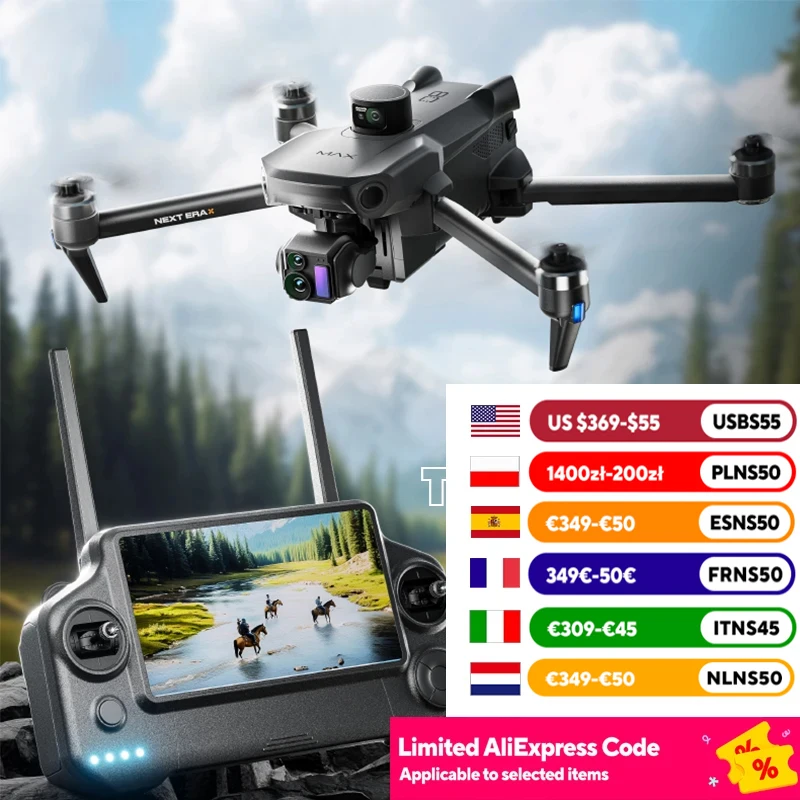
P7 MAX High-end Professional GPS Drone 8K With Screen Remote Control 20km Digital Image Tr
$437.63 $1301.22 on AliExpress
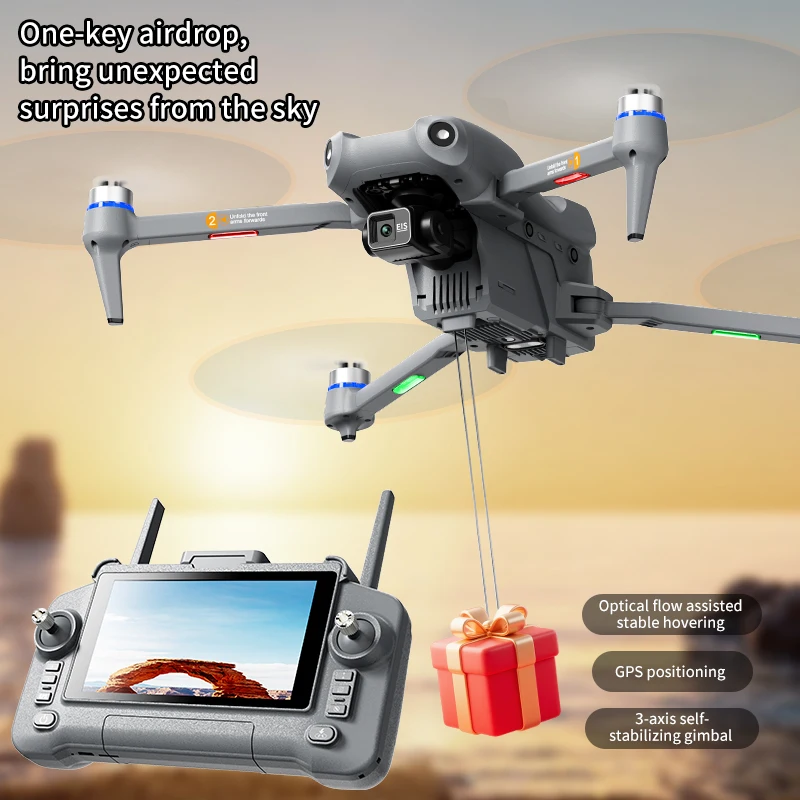
LYZRC L300-1 AIR MAX GPS Drone 4K 3-Axis Gimbal Laser Obstacle Avoidance One Key Airdrop T
$121.86 $322.37 on AliExpress

Potensic C0 4K GPS Professional Drone Max 6-KM, 3-Axis Gimbal, Visual Tracking, QuickShot,
$308.98 $1029.92 on AliExpress

Potensic C0 Mini Drone 3 Axis Gimbal 6KM GPS 4K Professional Camera Drones Brushless RC To
$365.21 $730.43 on AliExpress

S-X1 MAX GPS Drone Professional 4K Camera 3-axis Gimbal Aerial FPV Brushless Security Dron
$121.06 $242.12 on AliExpress
How to choose the best drones for your needs
- Regulatory class: Sub-250 g drones (Mini 4 Pro, Avata 2) avoid FAA registration in the U.S. and enjoy relaxed rules in the EU, UK, and Canada.
- Camera sensor size: 1-inch sensors (EVO Lite+) gather more light for cleaner night footage; 1/1.3-inch sensors (Air 3, Mini 4 Pro, Avata 2) strike a balance for daylight work.
- Obstacle avoidance: Omnidirectional systems (Air 3, Mini 4 Pro) enable confident autonomous tracking; three-way (EVO Lite+) covers the basics; FPV and trainer quads usually have none.
- Flight time vs. battery cost: Advertised maxima assume hovering in windless air. Budget 20\u201325 % less for real-world mixed flying and plan for 3\u20134 batteries per session.
- Controller ecosystem: DJI\u2019s RC 2 and RC-N2 share compatibility across Air, Mini, and Mavic lines, reducing future upgrade friction.
- FPV vs. stabilized: Stabilized camera drones (Air 3, Mini 4 Pro, EVO Lite+) hold position and horizon automatically. FPV drones (Avata 2, Cetus X) require manual throttle and attitude control\u2014expect a 20\u201340 hour simulator curve.
FAQ
Do I need a license to fly the best drones in 2026?
In the U.S., recreational pilots only need the free TRUST certificate. Drones 250 g and above require registration ($5 for three years). Commercial operations demand a Part 107 remote pilot certificate. EU rules follow the EASA open/specific/certified categories based on weight and risk.
Which drone has the longest real-world flight time?
The DJI Air 3 consistently delivers 35\u201340 minutes of mixed flying per battery, edging out the Mini 4 Pro (30\u201335 min) and EVO Lite+ (30\u201335 min). FPV and whoop-class drones remain under 5\u201323 minutes.
Can I use DJI goggles with non-DJI drones?
DJI Goggles 2/3/Inline work only with DJI O3/O4 air units. For analog or third-party digital links (Walksnail, HDZero), you need compatible goggles or a video receiver module.
What\u2019s the best way to learn FPV without crashing an expensive drone?
Spend 20\u201340 hours in a simulator (VelociDrone, Liftoff, Uncrashed) using your actual transmitter via USB. Then move to a durable sub-100 g whoop like the Cetus X before graduating to larger quads.
No single airframe wins every category, but the five models above cover the vast majority of pilot aspirations in 2026. Match your regulatory environment, camera priorities, and skill level to the right pick, invest in spare batteries and a simulator if you\u2019re going FPV, and you\u2019ll spend more time flying than troubleshooting. For a deeper dive into airspace rules, see the unmanned aerial vehicle overview on Wikipedia. Minecraft Touchscreen Interactive Smart Watch
“}